
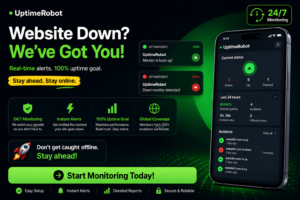
Read our expert 2026 Website Performance Monitoring guide. Discover how reliable website availability monitoring protects your business from unexpected website down errors and tracks robot uptime.
URL Slug
uptimerobot-review-website-performance-monitoring-guide
Introduction
Website downtime is invisible until it costs you money, traffic, and user trust. Imagine launching an ad campaign, driving thousands of visitors to your platform, and waking up to a server timeout error that went completely unnoticed for hours. Every minute your website is offline represents lost revenue, broken user relationships, and wasted marketing efforts. When your site experiences unexpected website downtime, having independent visibility is crucial.
Website performance monitoring changes this dynamic by acting as an independent, round-the-clock security guard for your digital assets. This comprehensive guide explores the mechanics of Website Performance Monitering, common speed bottlenecks, core vital metrics, and how dedicated external monitoring tools protect your online presence. Among these solutions, Uptime Robot stands out as a dependable option for keeping track of site availability, running an uptime checker, and ensuring consistent robot uptime.
Key Takeaways
- External Oversight Matters: Internal plugins fail when your server crashes; independent external monitors catch real-world outages instantly.
- Speed Equals Conversion: Even a one-second delay in page load times can drop conversion rates significantly.
- Proactive Alerts Prevent Loss: Automated alerts via email, SMS, or webhooks let you fix technical errors before users notice a website down status.
- Simplicity Wins: Effective website monitoring software focuses on core uptime checks, SSL verification, and clean status pages without bloat. Hyperping
What is Website Performance Monitoring?
Website performance monitoring is the continuous process of tracking a website’s availability, speed, and overall functional health. Unlike a human visitor who checks a site occasionally, a monitoring tool pings your server at regular intervals—often every 60 seconds—from various locations around the world.
Through diligent website uptime monitoring, these tools check whether your domain resolves correctly, your SSL certificate is valid, your database responds to queries, and your pages load within acceptable timeframes. If a check fails, the system immediately triggers an alert to notify administrators of potential website downtime.
Hyperping
Why Website Performance Monitoring Matters
A slow or offline website damages your brand reputation faster than almost any other technical issue. Modern internet users expect instantaneous responses. If a page takes longer than three seconds to load, a large percentage of visitors will abandon it entirely, often heading straight to a competitor.
From an SEO perspective, search engines factor page experience and site stability directly into ranking algorithms. Frequent occurrences where a site goes website down lead to crawler errors, indexation drops, and lower organic visibility. Utilizing regular website status monitoring safeguards both your user experience and your search engine rankings.
Why Websites Slow Down
Websites rarely slow down overnight due to a single issue. Usually, performance degrades incrementally as new elements are added to the codebase. Understanding common culprits helps you diagnose issues early.
- Slow Hosting: Budget shared hosting environments often suffer from resource throttling and “noisy neighbor” effects, causing random latency spikes.
- Large Images: Uncompressed raster images consume excessive bandwidth and delay visual rendering.
- Excessive JavaScript: Heavy client-side scripts block the main thread, freezing the browser while parsing code.
- Bloated CSS: Large stylesheets force browsers to wait before painting content on the screen.
- Overloaded Plugins: Accumulating too many active plugins introduces redundant database queries and execution overhead.
- Database Fragmentation: Unoptimized tables, orphaned post meta, and missing indexes slow down dynamic data retrieval.
- Third-Party Scripts: External tracking pixels, chat widgets, and ad networks introduce points of failure outside your direct control.
- Misconfigured DNS: Slow DNS name resolution delays the initial handshake between the user browser and your web server.
Community Insight (Reddit): Discussions across communities like r/webdev and r/WordPress frequently highlight that performance bottlenecks are rarely isolated. Developers emphasize that a combination of bloated asset delivery and unoptimized database queries often creates compounding latency that standard caching plugins cannot completely fix.
Website Performance Metrics
Modern performance optimization relies on measurable metrics rather than guesswork. Google’s Core Web Vitals and foundational timing metrics dictate how real users experience your site.
- LCP (Largest Contentful Paint): Measures loading performance. It marks the point in the page load timeline when the main text or image block has likely rendered. Good LCP is under 2.5 seconds.
- INP (Interaction to Next Paint): Evaluates interactivity by assessing how long the browser takes to respond visually to user inputs like clicks or taps. Good INP is below 200 milliseconds.
- CLS (Cumulative Layout Shift): Measures visual stability. It quantifies unexpected layout shifts of elements while the page is still loading. A score under 0.1 is ideal.
- FCP (First Contentful Paint): Marks the time when the browser renders the first piece of DOM content, giving users visual feedback that the site is loading.
- TTFB (Time to First Byte): Measures the duration from the user’s initial request to the receipt of the first byte of data from the web server.
How to Check Website Performance
Evaluating your website requires a mix of synthetic testing tools and real-world diagnostic utilities.
1. Google PageSpeed Insights & Lighthouse
- What it does: Analyzes desktop and mobile versions of your URL, providing diagnostic scores and specific recommendations based on lab data.
- Practical Steps: Navigate to the PageSpeed Insights web utility, enter your live URL, click Analyze, and review the performance score alongside Core Web Vitals field data.
2. Chrome DevTools
- What it does: Built directly into the Google Chrome browser, DevTools allows you to inspect network traffic, profile JavaScript execution, and audit local performance in real-time.
- Practical Steps: Open your website, right-click anywhere on the page, select Inspect, navigate to the Performance tab, and click the record button while reloading the page.
3. GTmetrix
- What it does: Generates comprehensive waterfall charts detailing individual asset loading sequences, page sizes, and historical performance trends.
- Practical Steps: Visit GTmetrix, paste your URL into the analysis bar, select your test server location, and evaluate the resulting waterfall graph for bottlenecks.
Community Insight (Reddit): Web engineers on r/webdev and r/TechSEO frequently discuss how synthetic lab data from tools like Google PageSpeed Insights, Lighthouse, and Chrome DevTools differs from real-world user data (CrUX). Network variability and older mobile devices heavily influence actual performance scores, making continuous external monitoring essential alongside local code auditing.
Common Website Performance Problems and Practical Fixes
Problem 1: Unoptimized Images
- Why it happens: Uploading raw camera photographs or large graphics directly into content management systems.
- How to Fix: Convert images to next-gen formats like WebP or AVIF, implement lazy loading for below-the-fold assets, and compress files before uploading.
Problem 2: Excessive JavaScript Execution
- Why it happens: Relying on heavy frameworks or embedding numerous third-party widgets.
- How to Fix: Defer non-critical JavaScript parsing, remove unused scripts, and audit your tag manager configurations regularly.
Problem 3: Uncached Database Queries
- Why it happens: Dynamic platforms generating fresh database queries for every single visitor.
- How to Fix: Implement robust page caching, object caching (such as Redis or Memcached), and clean up database transients.
Expert Tip: Always stage your performance fixes on a staging environment before pushing changes directly to your live production server to avoid breaking active user sessions.
Warning: Never delete database tables or core files without taking a complete, verified backup of your website and database first.
Introducing UptimeRobot
When you need peace of mind regarding your website’s availability, relying entirely on manual checks or internal plugins is insufficient. You need an independent watchdog that operates outside your hosting environment. This is where professional website availability monitoring solutions become indispensable.
What is UptimeRobot?
UptimeRobot is a cloud-based external monitoring service designed to track website availability, SSL certificate validity, port status, and server responsiveness.
Hyperping
Because it operates on external cloud infrastructure, it pings your web property from independent global networks to guarantee accurate robot uptime metrics. If your server experiences an unexpected outage, a network partition, or a website down emergency, the platform detects the interruption immediately and notifies your team.
Hyperping
Key Features
- Uptime Monitoring: Pings your HTTP/HTTPS endpoints, ping targets, or ports at regular intervals (as frequent as 1-minute checks) to monitor website uptime effectively. Catches server crashes and downtime incidents instantly before customers notice. uptimerobot.com
- SSL Certificate Monitoring: Tracks the expiration timeline of your SSL/TLS certificates to prevent embarrassing browser security warnings caused by expired encryption keys.
- Heartbeat Monitoring: Tracks scheduled background tasks, cron jobs, and automated backups, alerting you if a routine automated task stops executing. Hyperping
- Keyword Monitoring: Scans specific webpage bodies for the presence or absence of predefined text strings, helping you monitor website health against database error messages or script defacements.
- Public Status Pages: Provides clean, branded public pages displaying your current operational status and historical uptime records, which helps reduce support ticket volume. Hyperping
How to Set Up UptimeRobot
Setting up your first monitor takes only a few minutes. Follow these beginner-friendly steps to monitor website uptime:
- Navigate to the official UptimeRobot platform and create a free account.
- Log into your dashboard and click the + Add New Monitor button.
- Select your monitor type (choose HTTP(s) for standard websites). uptimerobot.com
- Enter a friendly display name for your project.
- Paste your full website URL, including the
https://prefix.
- Paste your full website URL, including the
- Choose your desired monitoring interval (e.g., 5-minute intervals on the free tier or 1-minute intervals on paid plans) to track ongoing uptime. uptimerobot.com
- Select your preferred alert contacts (email, SMS, or webhook integrations). Hyperping
- Click Create Monitor to activate your tracking profile.
Pricing, Pros, Cons, and Best For
Pricing Overview
UptimeRobot offers a functional free tier that includes 50 monitors checked at 5-minute intervals. Paid plans scale up to high-frequency 1-minute checks, advanced multi-location monitoring, SMS alert credits, team seats, and custom status pages with domain mapping.
Hyperping+ 1
Pros
- Generous free tier suitable for small blogs and personal projects looking for entry-level website uptime monitoring. Hyperping
- Extremely fast and straightforward setup process. G2
- Multiple notification channels including webhooks, email, and SMS to prevent long periods of a website down state. Hyperping
- Reliable external tracking unaffected by internal server crashes.
Cons
- Free tier monitoring interval is limited to 5-minute checks. Capterra
- Advanced team collaboration and granular user permissions require upgraded plans.
Best For
- Freelancers managing multiple client websites who require foolproof uptime tracking.
- Small business owners running e-commerce stores or lead generation funnels where avoiding website downtime is critical.
- Bloggers and developers who need straightforward, zero-fuss robot uptime management.
Best Practices
- Monitor Critical Endpoints: Do not just track your homepage. Add monitors for your login portal, user registration, and checkout gateway to catch any localized website down conditions.
- Configure Escalation Contacts: Ensure multiple team members receive critical alerts regarding any sudden website downtime to prevent missed notifications during off-hours.
- Leverage Maintenance Windows: Schedule planned downtime windows in advance to avoid triggering false alarms during server updates.
- Integrate Webhooks: Connect your alerts to messaging apps like Slack or Discord for rapid engineering responses. Hyperping
Community Insight (Reddit): System administrators on r/sysadmin and r/webhosting consistently emphasize that alert fatigue is real. They recommend setting threshold buffers or multi-location confirmation checks via tools like UptimeRobot infrastructure to ensure notifications only fire during genuine, sustained outages rather than transient network blips.
Frequently Asked Questions
- What is UptimeRobot? It is a cloud-based external monitoring service that checks website availability, SSL certificates, and server health around the clock. Hyperping
- Does UptimeRobot offer a free plan? Yes, it includes a robust free tier with up to 50 monitors checked every 5 minutes. Hyperping
- How often does UptimeRobot check websites? Free plans check every 5 minutes, while paid tiers support high-frequency checks every 1 minute. uptimerobot.com
- Can UptimeRobot monitor SSL certificate expiration? Yes, it tracks SSL certificates and alerts you before they expire. uptimerobot.com
- What is heartbeat monitoring? It tracks cron jobs and scheduled tasks by expecting a periodic “ping” from your server; if the ping stops, it sends an alert. uptimerobot.com
- Can I create a public status page? Yes, you can publish branded status pages to display uptime metrics to your users.
- How do alerts get delivered? Alerts can be sent via email, SMS, push notifications, and webhook integrations like Slack or Telegram. Hyperping
- Does UptimeRobot slow down my website? No, because monitoring requests originate from external servers, placing zero load on your hosting bandwidth.
- Is keyword monitoring available? Yes, it scans your web pages for the presence or absence of specific text strings.
- Can I monitor TCP ports and ping targets? Yes, custom port and IP ping monitoring are supported. uptimerobot.com
- What happens if my server goes down? UptimeRobot instantly logs the downtime event and triggers your designated alert channels. Hyperping
- Are multiple user seats supported? Yes, upgraded plans allow multiple team members to access the dashboard.
- How do I prevent false alarms? The system can verify downtime from multiple geographic locations before dispatching an alert. uptimerobot.com
- Is coding knowledge required to use UptimeRobot? None at all; the web dashboard is fully visual and beginner-friendly.
- Can I monitor internal staging sites? Yes, provided the IP address or URL is reachable by external nodes.
- How do webhook integrations work? Webhooks send real-time JSON payloads to third-party services whenever an incident state changes.
- What is the difference between internal and external monitoring? Internal plugins run inside your CMS and fail if the server crashes; external monitors check your site from the outside world.
- Can I customize my status page URL? Yes, paid plans support custom domain mapping for status pages.
- How do I upgrade my plan? You can upgrade directly from your billing dashboard via credit card or PayPal.
- Is UptimeRobot suitable for large enterprises? Yes, according to various UptimeRobot reviews, its high-frequency checks and enterprise features scale easily for larger organizations.
Final Verdict
Website monitoring is not an optional luxury; it is a foundational pillar of running a professional online presence. Without reliable visibility, minor server glitches can escalate into costly business disasters before you even realize something is wrong.
Based on overall user sentiment and UptimeRobot reviews, UptimeRobot provides a balanced, reliable, and user-friendly solution that cuts through unnecessary complexity. Its dependable external checks, straightforward alert configurations, and practical free tier make it an ideal choice for anyone looking to master uptime monitoring and eliminate unexpected website downtime.
Hyperping+ 1
References
Official References
- Google Search Central: https://developers.google.com/search
- PageSpeed Insights Documentation: https://developers.google.com/speed/docs/insights/v5/about
- Chrome Developers Performance Metrics: https://developer.chrome.com/docs/lighthouse/performance/
- UptimeRobot Documentation: https://uptimerobot.com/help/
Community References
- Reddit r/TechSEO Lighthouse and PageSpeed Data Variance: https://www.reddit.com/r/TechSEO/comments/1te30mg/lighthouse_and_pagespeed_different_data/
- Reddit r/Wordpress Monitoring & Status Page Solutions: https://www.reddit.com/r/Wordpress/comments/wqn3ae/monitoring_status_page_and_maintenance_solutions/
- Reddit r/webhosting Uptime Monitoring Infrastructure: https://www.reddit.com/r/webhosting/comments/1g20m50/uptime_monitoring_over_100_web_sites/