
Introduction
In today’s digital world, users expect a seamless experience across all devices—mobile, tablet, and desktop. As applications grow in complexity, maintaining a consistent and scalable user interface (UI) becomes a major challenge.
This is where design tokens in UI come into play.
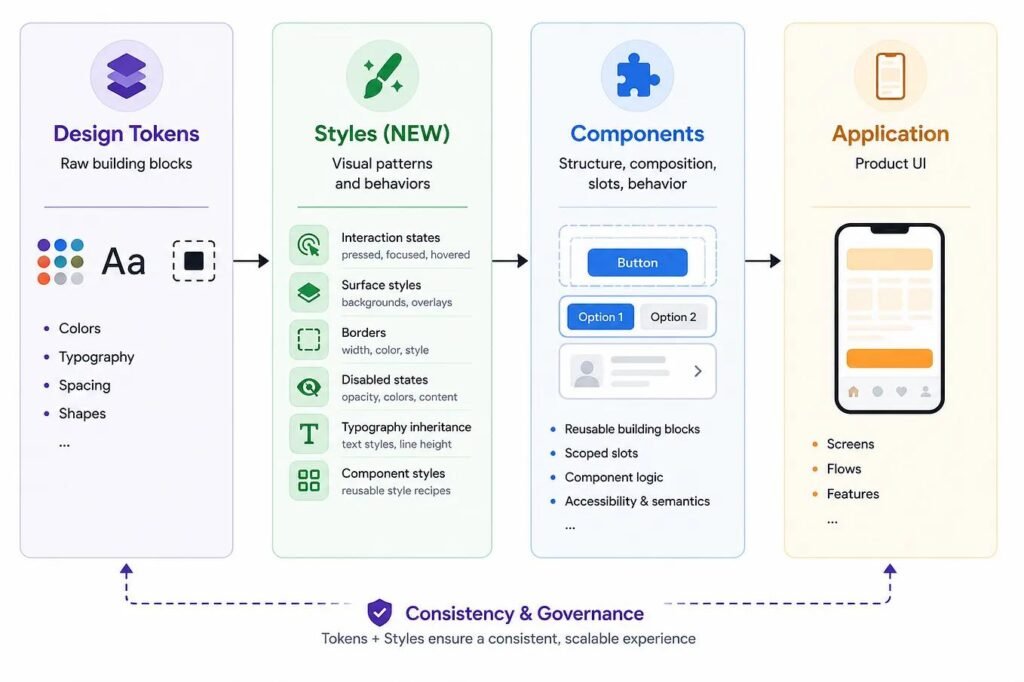
Design tokens help teams create scalable UI design systems by storing reusable design values like colors, spacing, and typography in a centralized way. Instead of repeating styles across different components, tokens allow you to define them once and use them everywhere.
In this article, you’ll learn what design tokens are, why they matter, and how they can transform your UI design workflow.
What Are Design Tokens?
Design tokens are named variables that store design values such as:
- Colors (e.g., primary, secondary)
- Font sizes
- Spacing
- Border radius
- Shadows
For example, instead of writing a hex color code multiple times, you define a token like:
primary-color: #007BFF;
Now, wherever you need that color, you simply use primary-color.
This makes your design system more organized and easier to maintain. If you ever need to change the color, you update it once—and it reflects everywhere.
Why Design Tokens Matter in UI Design
1. Consistency Across UI
Using design tokens ensures that all elements follow the same design rules. Buttons, headings, and layouts maintain a consistent look across your application.
2. Faster Development
Developers don’t need to redefine styles repeatedly. They can reuse tokens, speeding up the development process.
3. Easy Maintenance
Updating a design becomes simple. Change a token once, and the entire UI updates automatically.
4. Better Collaboration
Designers and developers can work more efficiently using a shared system of tokens, improving communication and reducing errors.
Design Tokens vs CSS Variables
Many people confuse design tokens with CSS variables, but they are not the same.
- Design tokens are platform-independent and part of a design system
- CSS variables are specific to web development
In practice, design tokens can be converted into CSS variables, making them usable in front-end code.
Benefits of Token-Based Design Systems
✅ Scalability
As your product grows, managing styles becomes easier. Tokens allow your UI to scale without losing consistency.
✅ Reusability
Once defined, tokens can be reused across multiple components and projects.
✅ Efficiency
Teams can build faster by relying on predefined design values.
✅ Reduced Errors
Since all styles come from a central source, inconsistencies and mistakes are minimized.
Real-World Examples of Design Tokens
IBM Carbon Design System
IBM uses design tokens in its Carbon system to maintain consistency across its products.
Microsoft Fluent Design
Microsoft leverages tokens in its Fluent Design System to ensure a unified experience across platforms.
Zalando Design System
Zalando uses tokens to improve development speed and maintain UI consistency.
Tools That Support Design Tokens
Several modern tools help you implement design tokens effectively:
- Figma (for design systems)
- Style Dictionary (for token management)
- Storybook (for UI component development)
These tools help teams manage and apply tokens across design and development workflows.
Best Practices for Using Design Tokens
- Use clear and meaningful naming (e.g.,
primary-color, notblue1) - Keep tokens centralized in one system
- Avoid hardcoding values in components
- Maintain proper documentation
- Regularly review and update tokens
Common Mistakes to Avoid
- ❌ Using too many unnecessary tokens
- ❌ Poor naming conventions
- ❌ Not documenting token usage
- ❌ Mixing hardcoded values with tokens
Avoiding these mistakes ensures your design system remains scalable and easy to manage.
Future of Design Tokens
As UI design systems evolve, design tokens are becoming a standard practice. With the rise of cross-platform applications, tokens help maintain consistency across web, mobile, and desktop environments.
In the future, more tools and frameworks will adopt token-based workflows, making them essential for scalable UI design.
Conclusion
Design tokens are a powerful way to build scalable and consistent UI design systems. They simplify development, improve collaboration, and make it easier to maintain complex applications.
If you want to create modern, scalable, and efficient user interfaces, adopting a token-based system is a smart move.
FAQ
What are design tokens in UI?
Design tokens are reusable variables that store design values like colors, spacing, and typography.
Why are design tokens important?
They ensure consistency, improve scalability, and speed up development.
Are design tokens the same as CSS variables?
No. Design tokens are platform-independent, while CSS variables are specific to web development.
How do design tokens help scalability?
They allow centralized control of design values, making it easier to manage large applications.